



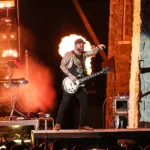
The country music industry has made greater effort in recent years to understand – and court – potential minority consumers. In that context, the decision by a handful of country artists to perform during Turning Point USA’s “All-American Halftime Show,” an alternative to the NFL’s official Super Bowl halftime entertainment, threatens to undermine the country industry’s efforts to widen its appeal.
Related


TPUSA chairwoman/CEO Erika Kirk announced plans to hold the show specifically after Bad Bunny – a bilingual superstar from Puerto Rico, an American territory – was announced as the Super Bowl’s halftime headliner. Over the ensuing months, TPUSA lined up Kid Rock, Brantley Gilbert, Lee Brice and Gabby Barrett for its counter-programming. Kirk has subsequently referred to her organization’s event as a “pro-American” alternative, a characterization that implies Bad Bunny is somehow un-American.
“This is one of the most divisive events that I can think of,” says Middle Tennessee State University Media and Entertainment dean Beverly Keel. “It’s clear what they’re doing. It is the white alternative to an American artist of Puerto Rican descent, so they’re not vague in their messaging, the event programmers.”
It’s not clear if the three country artists on the bill fully understood the impact of their decision to perform. The participation of Kid Rock, who is a multi-genre artist with a penchant for provocation, seems on point for his brand. The country acts declined to comment for this story. Brice, however, spoke to Fox News, saying the event provided an opportunity to “be a part of something that I believe in.”
He specifically cited the memory of TPUSA founder Charlie Kirk, who was killed in September during a public event at Utah Valley University in Orem.
“Charlie Kirk wanted everybody to have a microphone,” Brice said, calling the alternative halftime show “a celebration of what he believed in and what he brought to the table. And I’m just proud, you know? I’m proud to be an American, and I’m excited. I’m a musician. I get to go play music.”
Kirk, however, was more controversial than that characterization suggests. He was generally edited in conservative media in a way that made him an icon for freedom of speech, but some of his speech created critics who viewed him as racist, homophobic and misogynistic.
The artists performing on the “All-American Halftime Show” have every right to be there, but fears exist that they will be seen less as individual artists by some consumers than as a representation of country music. If those consumers see Kirk in the harsher framework and associate him with the whole of country, it could damage the genre as a whole.
“An artist has a right to do whatever they want to, as long as they understand the pros and cons and the consequences that come with that,” says Triple 8 Management artist manager Scott Stem. “My concern on this one is did they [know the direction] that Turning Point was going to take, as far as saying it’s a ‘pro-American’ thing when Turning Point is trying to turn it as an anti-Bad Bunny thing? Bad Bunny is most definitely American. He’s Puerto Rican.”
Several other country acts were approached about participating in the Turning Point event, notes F2 Entertainment president/CEO Fletcher Foster, and they balked at the opportunity, presumably believing the likely controversy outweighed the benefit of performing on national TV. Every artist has to make decisions about their participation based on their own circumstances. They are not required, said several people interviewed for this story, to factor in the impact of their decisions on the industry overall.
“Hopefully, most artists know who their base is already,” Foster says. “Whether it be extreme left, extreme right, right in the middle, you know, are they happy with that? Or do they want to grow it? I think that’s a lot of the questions. Are they fine with potentially alienating another audience?”
In the current cultural atmosphere, it is difficult to avoid those issues without appearing wishy-washy. The political parties are extremely bifurcated, and art reflects the society in which it’s created.
“If music is going to be honest and authentic, then in a polarized society, it’s gonna go left [or] right,” suggests Culture at Large podcaster Marcus K. Dowling. “There’s no way you could say, ‘OK, I’m making a song that occupies the middle.’”
Country music executives are working to make the genre an inclusive, big-tent format, and while that specifically means outreach to progressive-minded fans and/or non-white demographics, that also means that the industry should not knock the conservative voices in its midst.
“You can’t exclude somebody from that tent,” Dowling says. “Now, they could all stand in a corner of the tent, of course, because it’s the biggest tent. That’s the issue. I think that if you are a liberal-minded, non-conservative country music fan, when you say it’s the biggest tent, it’s the most inclusive it’s ever been. Inclusivity works both ways.”
Gilbert posted a message on Instagram on Friday (Feb. 6) that sought to separate his motivations from the hostility that birthed the event.
“I respect that some people may see this differently, but I’m not playing this show to be divisive,” he said. “I was offered this opportunity and imagined my kids watching their daddy perform at halftime during the biggest game in American football.”
“The way I treat people isn’t conditional based on what our differences may be,” he added. “I believe ‘united we stand, divided we fall,’ and my prayer for our country is that we stand united.”
Unfortunately, country music has a history that is less than welcoming. Until 2008, Charley Pride was the only Black artist to become a consistent hitmaker, and even then, Darius Rucker faced pushback from skeptical gatekeepers and fielded racist social media commentary, too. He succeeded despite those voices, and since then, country’s mainstream has also opened to Kane Brown, BRELAND, Jimmie Allen (whose momentum tanked after he was sued for sexual abuse), Blanco Brown and Shaboozey, who has notched two No. 1 singles on Billboard’s Country Airplay chart. Shaboozey gave an emotional speech after winning a Grammy during the pre-show ceremony on Feb. 1, noting the sacrifices made by his mother, a recently retired Nigerian immigrant who worked as a registered nurse in a hospital psychiatric ward while raising her children.
He dedicated his win to immigrants: “Thank you for bringing your culture, your music, your stories and your traditions here. You give America color.”
Reflecting the whole of America, numerous firms and organizations – including the Country Music Association and the Academy of Country Music – have developed programs in recent years to heighten opportunities for women, LGBTQ+ creators, and artists and executives of color. The fear surrounding the “All-American Halftime Show” is that the baggage that many associate with Turning Point might taint perceptions of country’s willingness to welcome everyone into its tent. One hope that’s been expressed repeatedly is that fans associate the event with Kid Rock as the headliner and are able to separate country from the TPUSA brand.
“I firmly believe that everybody loves a country music song, even if they don’t always want to admit it,” Stem says. “And I think that if you’re interested in exploring the genre, you’re going to explore it. The great thing about country music is it’s wide, and there’s a huge diversity there. There’s conservative artists and there’s liberal artists, and there’s songs for everybody all the way between.”
The challenge for the genre is to make that message clear, even when events or individual artists’ partnerships feed some of its stereotypical narratives.